
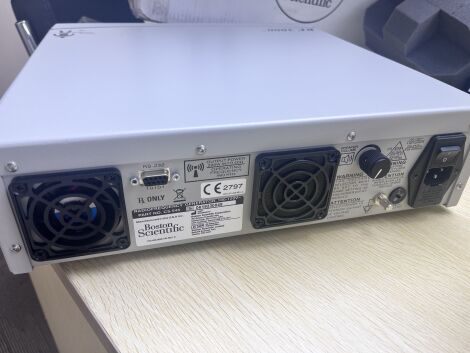
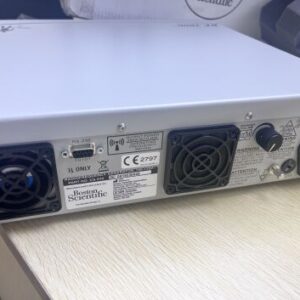
In the high-stakes environment of interventional oncology, equipment failure or inconsistent energy delivery is not just a technical glitch—it is a risk to patient safety and institutional reputation. The Boston Scientific RF3000™ is engineered as a robust “workhorse” for surgical departments and IR suites.
For procurement heads and Biomedical Engineers (BME), this system represents a low-risk, high-reliability asset. By utilizing an impedance-based feedback loop, the RF3000 mitigates the risk of tissue charring and incomplete coagulative necrosis, ensuring that procedures are successful the first time. Investing in genuine Boston Scientific RF infrastructure reduces long-term maintenance overhead and ensures full Clinical Compliance with international oncological standards.
Technical Features & Clinical Benefit Correlation
-
Real-Time Impedance-Based Control: Unlike time-temperature systems, the RF3000 monitors electrical resistance.
-
Benefit: Automatically identifies the “impedance roll-off” point, preventing overheating and ensuring maximal lesion volume while protecting adjacent healthy vascular and biliary structures.
-
-
Ionic Agitation & Frictional Heat Mechanism: Converts high-frequency AC into localized molecular friction.
-
Benefit: Ensures heat is generated within the target tissue (Internal Thermotherapy) rather than via external conduction, leading to rapid cell death and reduced procedural time.
-
-
Precision Depth Calibration: All compatible electrodes feature 1 cm interval depth markings.
-
Benefit: Provides tactile and visual confirmation during CT or Ultrasound-guided placement, minimizing the risk of accidental perforation or off-target ablation.
-
-
Expandable LeVeen™ Array Technology: Deployable multi-tine electrodes.
-
Benefit: Allows for the treatment of large-volume lesions (up to 5 cm) through a minimally invasive percutaneous entry, reducing patient recovery time compared to open resection.
-
B2B Value & Risk Mitigation Comparison
| Feature | Boston Scientific RF3000 (OEM/Certified) | Generic / Third-Party Refurbished Systems |
| Energy Delivery | Precise Impedance-Based Feedback | Unstable Power Output / Linear Timers |
| Clinical Safety | Prevents Tissue Charring & Hemorrhage | Risk of “Heat Sink” effect & incomplete ablation |
| System Compatibility | Full integration with LeVeen™ & Soloist™ | Potential Signal Latency or Connection Failure |
| Asset Lifespan | Engineered for high-volume clinical duty | Higher failure rates in power supply modules |
| Compliance | Meets global Hemodynamic & Safety standards | Questionable regulatory documentation |
Strategic FAQ: Addressing Procurement & Technical Intent
How does impedance-based monitoring reduce procedural risk in liver tumor ablation?
Traditional RF systems often rely on temperature sensors, which can be fooled by the “heat sink effect” (blood flow carrying heat away). The RF3000’s impedance-based control measures the actual physical change in the tissue. Once desiccation occurs, impedance spikes, and the system terminates power. This ensures a predictable, spherical lesion and prevents the carbonization of tissue that can lead to electrode sticking or post-operative complications.
Why is the RF3000 considered a superior ROI for oncology wholesalers?
The RF3000 is compatible with a vast ecosystem of consumables, including the LeVeen™ SuperSlim, Soloist™, and CoAccess™ electrodes. For wholesalers, this means a consistent pull-through of high-margin consumables. The generator’s reputation for stability and low signal latency makes it a preferred choice for hospitals looking to standardize their thermal ablation platforms.
How does the system handle different lesion sizes?
Through the use of various electrode configurations. For focal lesions, the Soloist single needle provides pinpoint accuracy. For larger masses, the umbrella-shaped array expands from the needle tip to create a predictable 2 cm to 5 cm zone of necrosis, allowing the clinician to customize the treatment to the specific clinical morphology of the tumor.
Technical Specifications
| Detail | Specification |
| Generator Model | Boston Scientific RF3000™ |
| Primary Control Mode | Impedance Roll-off Detection |
| Ablation Diameter | 2 cm to 5 cm (Electrode Dependent) |
| Compatible Electrodes | LeVeen™, Soloist™, SuperSlim, CoAccess™ |
| Mechanism of Action | High-Frequency Alternating Current (RF) |
| Clinical Indication | Thermal coagulation of soft tissue / Non-resectable tumors |
| Operational Interface | Intuitive LED Power & Impedance Displays |
| Safety Features | Automatic Power Termination & Visual/Audible Alerts |
For wholesale inquiries, bulk procurement, or technical compatibility assessments, contact our international trade department today.
Reviews
There are no reviews yet.