
How Global Healthcare Equipment Exchange Can Transform Your Business?
Two hospitals need the same ultrasound unit in the same month. The first buys through its incumbent local dealer and has the device on the ward in eleven weeks at list price. The second…
Two hospitals need the same ultrasound unit in the same month. The first buys through its incumbent local dealer and has the device on the ward in eleven weeks at list price. The second lists the requirement on a cross-border exchange, receives responses from four countries, and takes delivery in three weeks — but spends the intervening time assembling records that the first hospital never had to think about. The exchange did not remove that work; it moved it earlier, where it is cheaper.
Last updated:
What the exchange model changes, and what it does not
A global healthcare equipment exchange is a marketplace layer for medical equipment that already exists. It widens the set of sellers a buyer can reach and the set of buyers a seller can reach, and it holds payment until delivery is confirmed. What it does not do is certify the device, because certification is a property of the unit and its history rather than of the venue where the trade happened.
That distinction is the whole risk model, and it applies equally to the hospital buying and to the supplier selling surplus.
Why the traditional route is slow
The World Health Organization treats access to good quality, affordable and appropriate health products as indispensable to universal health coverage, and the recurring obstacle is not the absence of equipment but its distribution and condition. The procurement symptoms are familiar: hospitals wait months for spare parts or replacements, suppliers carry unsold inventory after a contract ends, and neither side has a transparent channel for used equipment.
The limitations of the traditional model are structural rather than accidental.
- Limited market reach. Clinics rely on local dealers, which restricts access to cost-effective alternatives from elsewhere.
- No transparency. Buyers cannot easily verify a product’s authenticity, sourcing or compliance history.
- High operational cost. Manual verification, paper contracts and complex logistics inflate the price and delay the acquisition.
- Risk exposure. Without a secure transaction mechanism, both sides carry fraud and payment-dispute risk.
How an exchange is put together
A working exchange centralises four capabilities. Participants and listings are vetted, so a seller has an identity and a history. Payment is protected, typically by escrow released only after inspection is confirmed. Market data — demand by category, price benchmarks — is visible, which is what makes negotiation fast. And after-sales support is integrated, so access to maintenance partners and spare parts does not end at delivery.
The trade-off against the traditional route is genuinely uneven, and it is worth being specific about where.
| Dimension | Traditional procurement | Exchange-based trade |
|---|---|---|
| Market reach | Regional dealers | Verified international network |
| Transaction security | Manual contracts | Escrow released after inspection |
| Product verification | Limited, seller-dependent | Inspection records travel with the listing |
| Time to purchase | Three to six months typical | Two to four weeks average |
| Cost transparency | Variable, negotiated in private | Published listings and price benchmarks |
| Asset reuse | Low reuse rate | Circular resale and trade-in |
The second and third rows are where the savings are earned. A faster trade is only cheaper if the record that justifies the price travels with the device.
The compliance work a cross-border trade adds
This is the part an exchange does not absorb, and the part a procurement lead has to own.
Provenance is answered from public records. The FDA’s UDI System identifies devices from manufacturing through distribution to patient use, and the identifier resolves in AccessGUDID; Devices@FDA searches premarket notifications and approvals, so the model can be matched against the submission that cleared it; and correction and removal actions are posted to the public recall database. Together those three answer whether the unit is what the listing says it is.
Condition is answered from the service file. For a refurbished device the FDA’s May 2024 Remanufacturing of Medical Devices guidance draws the operative line: servicing returns a device to the specification it was cleared with, while remanufacturing changes its performance, safety characteristics or intended use, and the entity that did the work takes on a manufacturer’s responsibilities. A supplier who cannot say which side of that line the work fell on has not finished the listing.
Destination rules are answered separately again. A device with a clean FDA record may still be the wrong purchase for a British hospital, because the MHRA sets out its own requirements for registrations in Great Britain, a UK responsible person for devices from outside the UK, UKCA marking and conformity assessment, labelling, and post-market surveillance. The two files answer different questions, and a cross-border trade has to assemble both.
A worked example: the landed cost of a cross-border purchase
This is a model with stated assumptions, not a quotation. The purchase price is a live listing; every other figure is arithmetic to replace with your own.
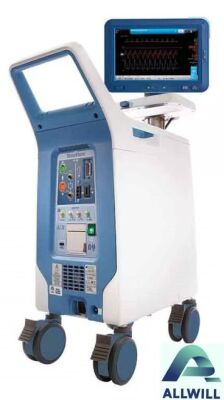
Take a Teleflex IAP-0700 system listed at $72,897. Assume freight and insurance at 9% of the purchase price, import duty at 2.5%, a pre-installation electrical safety test and calibration at a flat $600, an independent inspection before payment at $450, and a first-year service contract at 10%.
Freight and insurance is $6,561, duty $1,822, the service contract $7,290, and the fixed testing and inspection lines $1,050. Landed and supported for year one, the unit is therefore about $89,620, or roughly 23% above the listing price.
Change the assumption that matters. If duty is assessed at 0% because the classification is different, the same purchase lands about $1,800 lower; if the inspection is skipped, it lands $450 lower and the buyer has replaced a documented check with an assumption.
Why the model is spreading now
The equipment market is becoming more data-driven and modular, and circular procurement has moved from a sustainability slogan to a budget line. With regulatory standards tightening and capital budgets flat, an exchange is no longer an alternative channel so much as a second source — and the practical reason is that a hospital can now keep a documented record of a used device rather than take one on trust. The wider shift is visible in how the global X-ray equipment market and the equipment exchange model are developing alongside each other.
For a supplier, the same infrastructure answers the reverse question: where surplus inventory can be monetised without building a sales presence in every country.
References
- WHO: Medical devices — access to good quality, affordable and appropriate health products as a prerequisite for universal health coverage.
- FDA: Unique Device Identification System (UDI System) — labelling and the AccessGUDID search.
- FDA: Medical Device Databases — Devices@FDA (510(k) and PMA) and quarterly registration and listing.
- FDA: Remanufacturing of Medical Devices — final guidance, May 2024.
- GOV.UK / MHRA: Regulating medical devices in the UK — registrations, UK responsible person, UKCA marking and post-market surveillance.
Price the records with the device. Listings carry the model, the condition and the seller, so provenance and service history can be assembled before payment moves.
FAQ
Does trading through an exchange make a used device certified?
No. An exchange widens the market and protects the payment; certification is a property of the device, its manufacturer and its service history. The UDI record, the premarket reference and the recall status have to be checked on the unit itself, whichever venue it was listed on.
Why is a cross-border device sometimes cheaper and sometimes not?
Because the listing price is not the landed cost. Freight, insurance, duty, pre-installation testing, an independent inspection and the first-year service contract can add around 20% or more, as the worked example above shows. Compare landed and supported cost, not the headline figure.
What is the difference between servicing and remanufacturing on a refurbished unit?
Servicing returns a device to the specification it was cleared with. Remanufacturing changes its performance, safety characteristics or intended use, and the entity doing that work takes on a manufacturer’s regulatory responsibilities. The FDA’s May 2024 guidance exists to draw that line, so a seller should be able to say which applies.
Can a device with a clean FDA record still be wrong for a UK hospital?
Yes. Great Britain has its own registration requirements, UK responsible person arrangements and UKCA marking, so the MHRA file answers questions the FDA file does not. A cross-border purchase needs both assembled before the money moves.
How does a supplier get value out of an exchange rather than a buyer?
By reaching demand that local channels do not cover. A manufacturer holding unsold ventilators after a contract ends, or a clinic with underused systems, gains a documented route to international buyers and a resale value for idle assets without building a sales presence in each market.
Part of the Equipment Types & Classes guide.

