What Is the Medical Device Procurement Process?
There are seven steps in a medical device procurement process, and only one of them is about price. The other six exist because a device has to be justified clinically, funded, verified as marketable,…
There are seven steps in a medical device procurement process, and only one of them is about price. The other six exist because a device has to be justified clinically, funded, verified as marketable, sourced, contracted, received and then kept working — and a process that skips any of them moves the cost to a later stage where it is harder to fix.
Last updated:
The seven steps
The sequence below is the one used across US healthcare procurement, with the regulatory verification step made explicit because it is the step most often treated as a formality.
| Step | What it decides | The record it leaves |
|---|---|---|
| 1. Needs assessment | Whether the device is required, and for what caseload | Clinical requirement and specification |
| 2. Budget and capital approval | Whether the funding exists and the payback case holds | Costed business case |
| 3. Regulatory verification | Whether the model may lawfully be placed into service | Class, premarket reference, UDI, recall status |
| 4. Supplier evaluation | Who can supply it, and on what evidence | Scored supplier comparison |
| 5. Contract and pricing | Terms, warranty, service levels and exit | Signed contract |
| 6. Delivery and receipt | Whether what arrived matches the order | Inspection record |
| 7. Commissioning and handover | Whether it works, is safe, and staff can use it | Acceptance test and competency record |
Steps 1–2: clinical need and the money
Needs assessment starts from patient volume and service plans rather than from a device wish list, and it should involve the clinicians who will use the equipment and the biomedical engineers who will maintain it. The output is a specification naming the required performance, the interoperability requirements and the environment the device will sit in.
Capital approval follows, asking for a clear return calculation, a lifecycle cost review and a clinical justification. Financial models that ignore maintenance, depreciation and utilisation are the ones that come back for a second approval, so the model should carry all three from the start.
Step 3: the verification step, done properly
This is where a procurement process either has evidence or has paperwork. Four checks settle it, and each one is a public record.
Class and premarket route. The FDA assigns every device to Class I, II or III by risk; a Class I or II device that is not exempt needs a 510(k), and Class III requires premarket approval. Devices@FDA searches those submissions, so the model can be matched against the clearance that names it — and a device cleared for a different use is a different question.
Identity. The UDI System identifies devices from manufacturing through distribution to patient use, and the label identifier resolves in AccessGUDID.
Post-market status. Corrections and removals are published in the FDA’s recall and early-alert database, and a dated statement of recall status belongs in the file.
Condition, for refurbished stock. The FDA’s Remanufacturing of Medical Devices guidance, finalised in May 2024, draws the line between servicing, which returns a device to its cleared specification, and remanufacturing, which changes performance, safety characteristics or intended use and moves the manufacturer’s duties onto whoever did the work. Ask which applies, and against which specification.
A UK-bound purchase adds a fifth: registrations in Great Britain, a UK responsible person for devices from outside the UK, UKCA marking and conformity assessment, labelling, and post-market surveillance, as the MHRA sets out. The two files answer different questions.
Steps 4–5: supplier and contract
Vendor selection focuses on request-for-proposal evaluation, supplier scorecards and total cost of ownership. Assess quality certifications, delivery performance and service capability before discussing price, because those three decide whether the price is repeatable.
Contract strategy emphasises value-based purchasing, performance metrics and rebate structures, with service level agreements, warranty terms and compliance clauses in writing. Monitor contract performance afterwards: an unmonitored contract is where margin leaks.
The procurement checklist covers the documents each of these steps has to produce.
Steps 6–7: receipt, commissioning and handover
Receipt verifies quantities, documentation and condition against the order before acceptance. Commissioning then runs site preparation, installation, functional testing, calibration and electrical safety checks, and the sign-off is what converts a delivered box into a commissioned asset.
Handover includes training. A device nobody has been trained on is not deployed, and the competency record is the evidence that the training happened.
Supply chain and risk management sit across all seven
Supply-chain integration adds inventory optimisation, demand forecasting and lead-time management, aligning purchasing with real usage data so that stockouts and overstock both fall. Risk management adds supplier audits, quality-certification verification and recall-response planning, with contingency sourcing for the devices that cannot be allowed to run out.
Clinical and technology assessment belongs here too. Health technology assessment, usability testing and evidence-based comparison, ideally with a pilot, reduce adoption risk — and a pilot is also the cheapest way to test the utilisation assumption the business case depends on.
A worked example: what a faster process is worth
This is a model with stated assumptions, not a quotation. The purchase price is a live listing; the timings and volumes are placeholders.
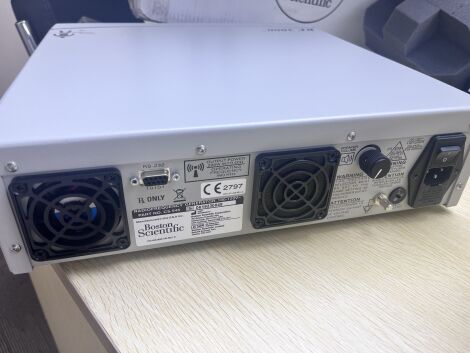
Take a Boston Scientific RF3000 radiofrequency ablation system listed at $42,625. Assume a 16-week conventional cycle against a 4-week platform-mediated one, six procedures a month at $700 of contribution, and a service contract at 10% of purchase price.
The twelve weeks saved is roughly 18 procedures, worth about $12,600 of contribution, against a five-year service line of about $21,313. The gain is real but smaller than the capital sum — which is the point: process speed is worth what the device earns per week, not a fixed percentage.
Change one assumption. If the device replaces one that has failed, those twelve weeks are not lost contribution but lost capacity, and the delay costs whatever the service cannot deliver. That is the case where paying for speed is obviously correct.
References
- FDA: Classify Your Medical Device — risk class and the premarket route.
- FDA: Medical Device Databases — Devices@FDA (510(k) and PMA) and quarterly registration and listing.
- FDA: Unique Device Identification System (UDI System).
- FDA: Medical Device Recalls and Early Alerts.
- FDA: Remanufacturing of Medical Devices — final guidance, May 2024.
Verify before you negotiate. Listings carry the model, the condition and the seller, so steps 3 to 5 can run in parallel rather than in sequence.
FAQ
Is there a single approved procurement process for medical devices?
No, but the sequences converge: needs assessment, budget approval, regulatory verification, supplier evaluation, contracting, receipt and commissioning. What differs between organisations is who signs each step and how much evidence the committee asks for, not the order.
Which step do organisations most often get wrong?
Regulatory verification, because it is treated as a document check rather than a search. The class, the premarket record, the UDI and the recall status are all public, and a process that does not run those four searches is relying on the supplier’s word for something it could confirm itself.
How should a team handle a device that is only available refurbished?
Treat it as a normal purchase with one extra question: whether the work performed was servicing or remanufacturing, and against which specification. Servicing returns a device to its cleared specification; remanufacturing changes it and shifts the regulatory duties to whoever did the work.
Where does e-procurement fit?
It automates the workflow around steps 3 to 6 — supplier comparison, compliance tracking, approvals and spend analytics — and reduces manual error. It does not remove the verification step; it makes the result easier to retrieve at audit.
What should the business case contain at step 2?
A return calculation, a lifecycle cost review covering maintenance and depreciation, a utilisation assumption, and the clinical justification. The utilisation assumption is the one to test, because it decides whether the device earns its keep.
Part of the Medical Equipment Distribution & Wholesale Channels guide.